Console Window
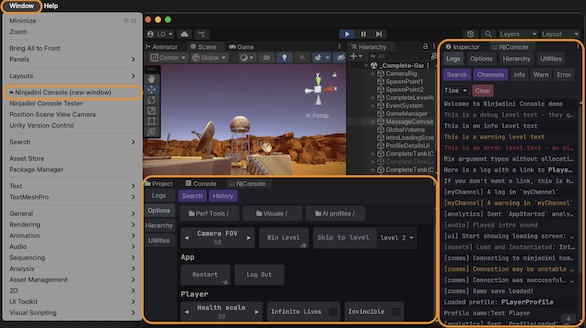
🧩 Open console window in editor
- Navigate to:
Window > ⌨ Ninjadini Console (new window) - Select it again to open another window — you can have several open at once.
- Right-click a GameObject in Unity’s Hierarchy →
Inspect in ⌨ NjConsoleopens it straight in the console’s Object Inspector.
🕹️ Open console in game view
- Keyboard: Press the
`key (top-left on US keyboard). Press again to close. - Keyboard:
Shift+`opens the console straight into the Command Line prompt. - Mouse: Hold at the top-left corner of the game screen for 1 second.
- Mouse (alternative): Double-tap the top-left corner of the screen.
You can customize these triggers in Project Settings > Ninjadini ⌨ Console > Playmode Overlay.
👀 Sidebar Tips (During Play Mode)
- Press and hold any empty area of the sidebar to temporarily peek behind the console.
- On screens 650px or wider (or taller), a window mode button at the end of the sidebar lets you undock and resize the overlay.
🧭 The panels
| Panel | What it does | Docs |
|---|---|---|
| Logs | Log viewer, filtering, search, and the Command Line | Logging, Command Line |
| Options | Your cheats / debug menu, plus shortcuts | Options Menu |
| Hierarchy | Live scene tree — drill into GameObjects and their components | Inspector & Utilities |
| Utilities | FPS/memory monitors, PlayerPrefs, editable screen & quality settings, device info, log export, UI scale | Inspector & Utilities |
| Editor Options | Options that work outside play mode (editor window only) | Options Menu |
Every panel except Logs can be switched off for player builds under ... > Features, and you can add your
own — see Custom Panels.
🔐 Setting up Access Challenge
Gate the console behind a passcode:
- Go to Project Settings → Ninjadini ⌨ Console → Playmode Overlay → Access Challenge
- Click
Add Access Challenge - Select
Secret Pass - Set a passcode and (optionally) a hint message
- Press
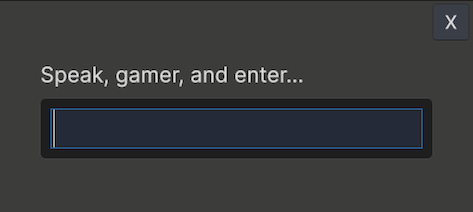
Apply changes - Activating the overlay in play mode now prompts for the passcode
🔧 Advanced topics
⚡ Auto start console
The overlay auto-starts in play mode. With activation triggers set up (` key, hold at corner) it
stays hidden until one fires.
Disable auto start under Project Settings > Ninjadini ⌨ Console > Playmode Overlay, then start it yourself
with NjConsole.Overlay.EnsureStarted() — which also starts hidden if you have triggers. To force it open,
NjConsole.Overlay.ShowWithAccessChallenge().
🕹️ Setting up your own activation trigger
Roll your own way to open the overlay in play mode. ConsoleKeyPressTrigger and ConsolePressAndHoldTrigger
are the built-in examples to crib from.
- Create a class that implements both
IConsoleOverlayTriggerandIConsoleExtension. - Add [Serializable] attribute to the class.
- Go to
Project Settings > Ninjadini ⌨ Console > Playmode Overlay > Add Trigger> add your new class - Press
Apply changes
Example code below toggles the overlay on shift + right mouse click.
[System.Serializable]
public class ShiftRightClickConsoleTrigger : IConsoleOverlayTrigger, IConsoleExtension
{
    ConsoleOverlay _overlay;
    public void ListenForTriggers(ConsoleOverlay overlay)
    {
        _overlay = overlay;
        overlay.schedule.Execute(Update).Every(1);
    }

    void Update()
    {
        // using old input manager...
        if (Input.GetMouseButtonDown(1) && (Input.GetKey(KeyCode.LeftShift) || Input.GetKey(KeyCode.RightShift))) {
            if (_overlay.Showing) {
                _overlay.Hide();
            } else {
                _overlay.ShowWithAccessChallenge();
            }
        }
    }
}
Use
ShowWithAccessChallenge()rather thanShowWithoutAccessChallenge(), so a configured challenge still applies.
🔐 Setting up your own custom access challenge type
Tie the gate into your own login system, or anything else.
- Create a class that implements both IConsoleAccessChallenge and IConsoleExtension.
- Add [Serializable] attribute to the class.
- Go to
Project Settings > Ninjadini ⌨ Console > Playmode Overlay > Add Access Challenge> add your new class - Press
Apply changes
This one asks a maths question before letting you in.
[System.Serializable]
public class MathsAccessChallenge : IConsoleAccessChallenge, IConsoleExtension
{
    static bool _passed; // persist this in PlayerPrefs or similar

    public bool ShowingChallenge { get; private set; }

    void IConsoleModule.OnAdded(ConsoleModules console)
    {
        _passed = false;
        ShowingChallenge = false;
    }

    public bool IsAccessChallengeRequired()
    {
        return !_passed;
    }

    public void ShowChallenge(Action callbackOnSuccess)
    {
        ShowingChallenge = true;
        var numA = UnityEngine.Random.Range(1, 100);
        var numB = UnityEngine.Random.Range(1, 100);
        // This could be anything, like your own sign in dialog. We are just using the text prompt from Console for simplicity.
        ConsoleTextPrompt.Show(new ConsoleTextPrompt.Data()
        {
            Title = $"{numA} + {numB} = ?",
            ResultCallback = (response) =>
            {
                if (response == null) // user pressed close btn
                {
                    ShowingChallenge = false;
                    return true;
                }
                if (int.TryParse(response, out var responseInt) && responseInt == numA + numB)
                {
                    ShowingChallenge = false;
                    _passed = true;
                    callbackOnSuccess();
                    return true;
                }
                return false; // returning false keeps the prompt open
            }
        });
    }
}
🎛️ Controlling the overlay from code
NjConsole.Overlay.EnsureStarted();          // start it, hidden, waiting for triggers
NjConsole.Overlay.ShowWithAccessChallenge();// show, running the access challenge first
NjConsole.Overlay.Show();                   // show, skipping the access challenge
NjConsole.Overlay.Hide();
NjConsole.Overlay.Showing;                  // bool

NjConsole.Overlay.SetActivePanel<ConsoleOptions>();   // or by Type, or by panel name string
NjConsole.Overlay.ActivePanel;
NjConsole.Overlay.Context;                  // the ConsoleContext for this overlay
NjConsole.Overlay.Destroy();
All safe no-ops when NjConsole is stripped with NJCONSOLE_DISABLE — see Build customization.